With the love for food and community, SPEC and Kits Neighborhood House (KNH) are putting together ten Pocket Markets this summer to nurture the growing local food movement and boost the local economy.
Pocket Markets play an important role in supporting the production and distribution of local food. The markets help bridge the gap for local farmers, urban backyard growers and local food eaters by providing an alternative market format that adds to the current make-up of the farmer’s market world.
Join us in celebrating community and the love for local food, starting every Thursday July 7 until Sep 8, from 3 pm to 7 pm at Kits Neighbourhood House (2325 7 Ave West). In addition to tasty food, SPEC will offer workshops on Winter Gardening, Eating Local on a Budget and plenty of other workshops! (We encourage curious people to keep an eye on our website for updates).
Vendors at the July 7th market
* Cherry Lane Farm
* SOLEFood Farm
* Salt Spring Coffee Co.
* Giddy up and Grow
* The World in A Garden
The vendors will vary from market to market. If you want to become a market vendor to sell eggs, fresh produce or baked treats, please contact Sara Blenkhorn at sarablenkhorn@gmail.com.
Workshop offered on July 7
Workshop #1 - Climate Change and Year-Round Gardening.
Time: 5 pm to 6pm.
Is your garden prepared for an unpredictable climate? Explore how climate change can affect the productivity of urban farms and gardens and how certain practices can minimize greenhouse gases in small-scale agriculture. Participants will learn climate-modifying techniques to extend the season, including mulching, greenhouses, coldframes and cloches. (All workshop are free but donations are always appreciated!).
The Pocket Market Voucher Program
Eating local is unfortunately not always the most affordable option for your pocket. At the Westside Pocket Market we want ALL community members to be able to enjoy healthy food, this is why we are launching the Pocket Market Voucher Program. The vouchers program will help low income families and individuals to access nutritious food by taking the financial edge off eating local. For more information on how to access the Pocket Market Vouchers, please contact Kits Neighborhood House at 604-736-3588.

Thursday, June 23, 2011

Sunday, June 12, 2011

The Beds are Almost Full


Today we harvested lettuce thinnings, chives, arugula and mesclun.
The beds are almost at capacity now - empty spaces were seeded with cucumbers, dill, parsnips, mesclun, mixed lettuce and frisee.
Fruit and Flowers Too


Looks like we will have a good crop of raspberries for July munching. The Lupins are also now at their peak - good for bringing pollinators into the garden.
Wednesday, June 8, 2011
Time to Plant Summer Veggies
Important to keep records of what we've planted, including date sown, germination time and general progression of the crop. The June 5th planting included beans, beets, parsnips, basil, hot pepper transplants and more tomato transplants - you can never have too many tomatoes...........


More Progress in the Garden


And a few more pictures - have a look at the potatoes - amazing growth - and the strawberries are loving the company of garlic and the newly added tomato transplants
First Harvest June 5


Time to harvest! And what a great morning we had for the event .....
We cleared out the radish beds to makes way for planting summer veggies, and the spicy mesclun mix and toy choi were also shared by all
Monday, June 6, 2011
Summer's Fast Approaching June 3


And a few more pictures of progress to June 3. Notice how healthy the leaves of the Oriental greens are with no flea beetle or slug damage. The toy choi needs to be harvested - flower buds just starting.
Due to the number of days with rainfall during May the garden did well with a once or twice weekly watering - with the weather so far in June we will have to keep an eye on our newly seeded beds.
And on to May 28
Looking good, and a new seeding of arugula in bed 1 has now sprouted - arugula can be seeded from March through September - and harvested at almost any size before it goes to seed. The toy choi is best suited to spring and fall plantings.


Fast Forward To May 19
Well May's weather was not much better than April's but that didn't stop our crops from growing. Here are a few pictures of the garden's progress on May 19. Spicy mesclun mix, toy choi seeded in bed 1 on April 26th. The bed also contains larkspur and strawflower transplants. I'm sure the leafy greens' progress can be attributed to the alfalfa meal added prior to seeding.
Also, we have overwintered garlic and potatoes starting to take off in two of the garden's other beds.


Also, we have overwintered garlic and potatoes starting to take off in two of the garden's other beds.


Thursday, April 21, 2011
April and things are happening in the City Square Communal Garden

We've had every kind of weather this April but our cold hardy seeds planted in late March have grown into their first leaves. Things like radishes, arugula, spinach, peas and kale can all be planted outside early.


The garlic we planted last fall is going strong. Last week we nestled some strawberries in the garlic bed.


We've also made sure to plant flowers to attract pollinators to our garden.

Come join us at the garden! we are meeting every 2nd Sunday at 11am, next one is May 1st
Wednesday, February 2, 2011
Soils
It's official, spring is on its way. As you flip through seed catalogues or take stock of your own seed collection and plan this year's garden don't forget the first step in gardening - assuring healthy soil.

Here is a site with a good list of different soil tests you can do to see if your garden is ready Dave's Garden
Ways to improve soil included adding leaf litter (hopefully you did this last fall, and your leaves are all molding and breaking down nicely) - shredding leaves with a lawn mover is also great. Sea weed collected and rinsed to remove salt can add valuable nutrients back into your soil. Again, shredding would be useful. You can add well-rotted compost and/or organic fertilizer before you plant your seedlings out in March (too early and the nutrients will leach out with rain). The jury is still out on Dolomite Lime, with local master gardeners suggesting only adding the amendment if a soil test shows low pH.
Happy preparations!
- marnie

Here is a site with a good list of different soil tests you can do to see if your garden is ready Dave's Garden
Ways to improve soil included adding leaf litter (hopefully you did this last fall, and your leaves are all molding and breaking down nicely) - shredding leaves with a lawn mover is also great. Sea weed collected and rinsed to remove salt can add valuable nutrients back into your soil. Again, shredding would be useful. You can add well-rotted compost and/or organic fertilizer before you plant your seedlings out in March (too early and the nutrients will leach out with rain). The jury is still out on Dolomite Lime, with local master gardeners suggesting only adding the amendment if a soil test shows low pH.
Happy preparations!
- marnie
Wednesday, January 5, 2011
School Garden Start-up Guide
Are you interested in starting a school garden but don't know where to start?
SPEC has recently released our introductory guide to starting a school garden: SPEC's School Gardens Start-up Guide
We are also working on more resources so visit www.spec.bc.ca regularly for updates.
- marnie
SPEC has recently released our introductory guide to starting a school garden: SPEC's School Gardens Start-up Guide
We are also working on more resources so visit www.spec.bc.ca regularly for updates.
- marnie
Thursday, October 7, 2010
Planting Garlic & Quote About Eating
Happy Thanksgiving weekend.
Take a look at this article on garlic (It's time to plant!)
And here's a nice quote, fitting for the weekend ahead:
“Eating is the taking into our beings the offerings of those who have worked to bring it to us and the offering of the Divine, whose creation it and we are. Eating is not an act to be taken lightly. All that is involved demands respect and attention – mindfulness. Grace before meals is appropriate, no matter what our religious convictions, as a centering process. Eating is a rite, especially eating together. A lot has happened to make this eating possible. “A lot has been sacrificed,” as the pig said to the chicken after the bacon and egg breakfast. At least let us revere this with our attention and conscious enjoyment. People will eat less and enjoy more if they always sit down to eat, take a moment to say grace or focus on what they are doing, smell, look, appreciate, eat slowly with small bites and much chewing.”
Sylvia Mangalam,
Founding member of the Food Action Committee, Ecology Action Centre
- marnie
Take a look at this article on garlic (It's time to plant!)
And here's a nice quote, fitting for the weekend ahead:
“Eating is the taking into our beings the offerings of those who have worked to bring it to us and the offering of the Divine, whose creation it and we are. Eating is not an act to be taken lightly. All that is involved demands respect and attention – mindfulness. Grace before meals is appropriate, no matter what our religious convictions, as a centering process. Eating is a rite, especially eating together. A lot has happened to make this eating possible. “A lot has been sacrificed,” as the pig said to the chicken after the bacon and egg breakfast. At least let us revere this with our attention and conscious enjoyment. People will eat less and enjoy more if they always sit down to eat, take a moment to say grace or focus on what they are doing, smell, look, appreciate, eat slowly with small bites and much chewing.”
Sylvia Mangalam,
Founding member of the Food Action Committee, Ecology Action Centre
- marnie
Thursday, September 23, 2010
September Harvest and Fall Planting SPEC Rooftop
Summer seems to have ended but our rooftop garden is now ready for winter.
We harvested lots of onions and carrots.

As well as many red and green tomatoes.

Tomatoes need to be harvested, even if still green. If left on the plant during cool temperatures and rain they will develop blight and turn black instead of red. Wrap your green tomatoes in newspaper and store them in a cool dark place until they ripen.

Tomato plants were then removed and put in our yard waste bins for composting (blight may spread in a cold composter, but in Vancouver yard waste is mechanically composted using heat).
We also planted some more fall crops (many winter crops should be planted in July or August, but due to extreme heat on our roof in these months not many seedlings were started successfully)
We planted overwintering broccoli starts, kale seeds and garlic after amending the soil with compost from our worm bin composter.


Garlic is grown by separating the cloves of the garlic bulb and planting pointy-end up roughly 4 inches deep in the soil. Each clove will form a new bulb. We simply bought local organic Red Russian garlic from a nearby grocer.
Happy autumn!
- marnie
We harvested lots of onions and carrots.

As well as many red and green tomatoes.

Tomatoes need to be harvested, even if still green. If left on the plant during cool temperatures and rain they will develop blight and turn black instead of red. Wrap your green tomatoes in newspaper and store them in a cool dark place until they ripen.

Tomato plants were then removed and put in our yard waste bins for composting (blight may spread in a cold composter, but in Vancouver yard waste is mechanically composted using heat).
We also planted some more fall crops (many winter crops should be planted in July or August, but due to extreme heat on our roof in these months not many seedlings were started successfully)
We planted overwintering broccoli starts, kale seeds and garlic after amending the soil with compost from our worm bin composter.


Garlic is grown by separating the cloves of the garlic bulb and planting pointy-end up roughly 4 inches deep in the soil. Each clove will form a new bulb. We simply bought local organic Red Russian garlic from a nearby grocer.
Happy autumn!
- marnie
Monday, September 6, 2010
Summer's End
As the summer winds down:

We dry and collect seeds to use again next year or for winter crops (some seeds are very easy to save and others take a bit of effort but you can replant most things from your garden for free if you save your own seed).
 Compost plant debris left over from the growing season
 And plant winter crops that will continue to grow for the cold season to produce food early in the spring, like broccoli, kale, and brussel sprouts.


We dry and collect seeds to use again next year or for winter crops (some seeds are very easy to save and others take a bit of effort but you can replant most things from your garden for free if you save your own seed).
 Compost plant debris left over from the growing season
 And plant winter crops that will continue to grow for the cold season to produce food early in the spring, like broccoli, kale, and brussel sprouts.
Sunday, September 5, 2010
Tomato Harvest Time
The beginning of September means lots of tomatoes are ready for eating. We have so many beautiful ones. Tiger tomatoes, and Sun Drop cherry tomatoes are the ones we have mostly harvested so far.

We've also harvested more Tromboncino zucchinis.

 A pile for each gardener to take home.

We've also harvested more Tromboncino zucchinis.

 A pile for each gardener to take home.
Mushroom Patch Experiment
This week we tried planting a mushroom patch from 'mushroom spawn'.

It comes in a bag and needs to be layered with straw or hardwood chips and covered with cardboard in a moist cool place in the garden.
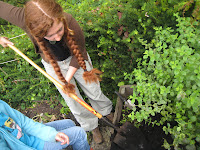
First we dug a space 10 inches deep to grow them in.

Laid newspaper down in the space.

Then layered the mushroom spawn with layers of straw and hardwood pieces.

Watered it, and covered it all with sheets of cardboard.
In a few weeks, once we can see the mycorrizae, we will add 2 inches of soil on top. It will be next spring before we have any mushrooms.
This type of mushroom creates a mycorrizal network of roots underground that feed beneficial nutriets to nearby plants. Plus they are edible and apparently delicious. So we hope they grow.

It comes in a bag and needs to be layered with straw or hardwood chips and covered with cardboard in a moist cool place in the garden.

First we dug a space 10 inches deep to grow them in.

Laid newspaper down in the space.

Then layered the mushroom spawn with layers of straw and hardwood pieces.

Watered it, and covered it all with sheets of cardboard.
In a few weeks, once we can see the mycorrizae, we will add 2 inches of soil on top. It will be next spring before we have any mushrooms.
This type of mushroom creates a mycorrizal network of roots underground that feed beneficial nutriets to nearby plants. Plus they are edible and apparently delicious. So we hope they grow.
Thursday, August 26, 2010
Birds and Bees

Both birds and bees are important to your garden. They pollinate crops and flowers, as well as prey on detrimental pests.


Subscribe to:
Posts (Atom)